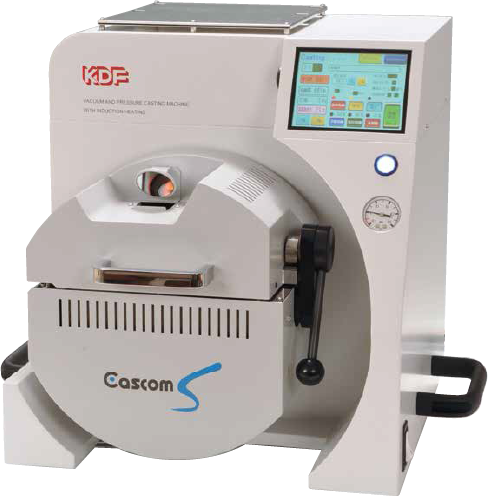
What is Cascom S/SE?

In the past, the Cascom series was a heater-heated casting machine, where the temperature rises slowly as electricity is applied to it, and the metal is melted at about 1,500 degrees Celsius. Since anyone can cast at the touch of a button, our market share has expanded considerably. However, when we try to melt metals with a high melting point, such as cobalt and nickel, which are used for dentures, we face issues such as time and running costs for consumables.
Therefore, Cascom S/SE uses high frequency for casting. Since the high frequency heats the material itself, it only takes about two minutes for the temperature to rise to 1,500 degrees Celsius, whereas it would take twenty to thirty minutes if we employ the heater heating method. This saves time and money.

What are some of the functions that are unique to Cascom S?

Since high frequencies cause a rapid rise in temperature, a temperature sensor is placed directly into the metal so that even metals with low melting points can be cast without overheating. In addition, the LCD touch panel has been designed to be interactive for improved operability and to allow easy casting at three different stages: pre-melting, sustained melting, and full melting. Minor adjustments have also been made to improve seemingly insignificant details, such as the base on which the ring is placed and the way the temperature sensor is stored.
※This story excludes Cascom SE. Currently Cascom S is supplying only for domestic market in Japan.

When trying to commercialize Cascom S/SE,
what were some of the struggles you had?

Since Cascom S/SE was the first high-frequency equipment that we were working on internally, it took us three to four years to acquire the knowledge and technology we needed to produce it. We purchased numerous machines that we thought would be useful for our research. However, since we were working with a very large current, we came across a lot of problems, such as short-circuiting the power supply and electrocution. In addition, Cascom S/SE has also adopted the method of pouring metal into molds through rotation and pressurization. It took about a year of repeated casting of different metals for us to figure out an optimal casting timing for Cascom S/SE.

How was Cascom S/SE received?

We have had users telling us that Cascom S/SE is easy to cast with. Quite a few of our users have also noted the machine’s durability. While it is important to obtain patents and announce new technologies, I see it as more important to make intuitive and durable products for customers to use. Even then, we have seen complaints and malfunctioning, so I believe that we still have a long way to go in terms of perfecting Cascom S/SE.

What are your plans for future product development

We are developing a compact, space-saving, high-speed zirconia sintering furnace by applying Cascom S/SE’s technology. Since we are specialized in machines that operate with heat sources, we would like to continue to develop products that make use of this technology. We would also like to devote our efforts to products used at dental clinics, such as machines for oral care and sterilizers.

As one of Cascom S/SE’s developers,
what were some of the best moments you have had?

It may sound like a cliché, but the best moment I had was when the machine worked exactly the way I had wanted it to based on our ideas and designs. I’m sure it’s the same for developers in all fields, but I tend to get good ideas when I’m not working, like before going to bed, or in the bathroom, or while hanging out. At such times, I send ideas to my own email. Sometimes I fail to bring to fruition what I do because of overthinking. The dental industry still has a lot of unmet needs, and it is with sincerity that I would like to continue to contribute to the industry by making machines that can actually solve the problems that the industry faces.

Product x Development Episode

What led you to create this product?

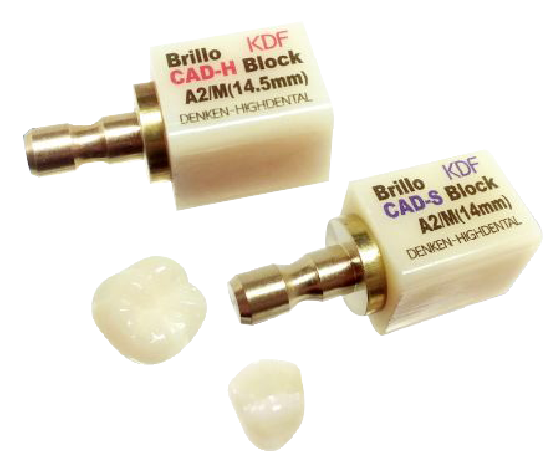
The wave of digitalization has been massive across the dental industry. Our company had no products supporting digitalization, so I had the idea of using Brillo as a handhold to make a jump forward.

How long did it take to go from
development to productization?

Development of the first Brillo CAD-S Block began in July 2014, and the product was commercialized in October 2017. There was an interruption of two and a half years along the way, so it was really a year and three months. Creation of the product went through a lot of twists and turns, but it’s now our mainstay product.

What is the origin of the name “Brillo”?

This is a product with excellent polishing performance. One of our employees christened it “Brillo,” which means “shine” in Spanish.

Both Brillo CAD-S Block and Brillo CAD-PREMIUM Block are for premolars. What is the difference between the two?

Brillo CAD-PREMIUM Block has a higher strength.
Even with the same premolar coverings, the classification is divided into two for Japanese insurance purposes, so we segregated the product into two types of materials.

In creating the product,
what points did you struggle with?

We were a latecomer manufacturer in CAD/CAM crown materials, so to grab market share we had to give the product features not offered by the earlier manufacturers. We closely analyzed products from other companies and found that polishing work after machine grinding took time. From that, we decided, all right, we’ll start on development under the concept of making a product with excellent polishing performance. However, as there’s a trade-off between polishing performance and strength, it took a lot of time to formulate the material to enhance its polishing performance while retaining its strength.

How has the response from customers been?

We’ve received actually a lot of comments about the ease of polishing. I was really happy when we found that we’d been able to create the product in line with our concept. I felt strongly that a product brought about through strong convictions can be properly appreciated in the world, even for a latecomer.

What benefits do dental technicians gain by using the product?

It shortens the time required for polishing, so I think it leads to shorter task time.
Dental technician is a considerably difficult job, and technicians work from early in the morning until late at night. Polishing is a task that can’t be avoided, so we hope we can lighten the burden on technicians even a little through the use of Brillo.

What is your schedule for rollout of future products?

Brillo is made from materials eligible for insurance coverage in Japan. We also plan to release a product made with a material called zirconia, used in medical treatment outside of Japanese insurance coverage. As another digitalization-related product, we’re also moving ahead with development of a 3D printer.
At present, over half of dental technicians in Japan are over 50 years old, and new successors are decreasing in number. At the same time, the number of patients is not declining, so it’s essential to boost work efficiency through digitalization. However, in contrast to fillings and caps, for which digitalization is advancing, dentures aren’t making the migration from analog. From here on out, what we can offer in the area of dentures will be a major challenge.

Do you have any closing comments?

I think that development is an area where you take 100 shots but actually hit with 10 or fewer. Nothing good will come of development unless you ask what went wrong to cause failures, think things through, and move ahead. I’ve taken the lesson to heart that development-centered products will never sell unless we can offer service that really takes in customers’ concerns and demands.

Product x Development Episode